


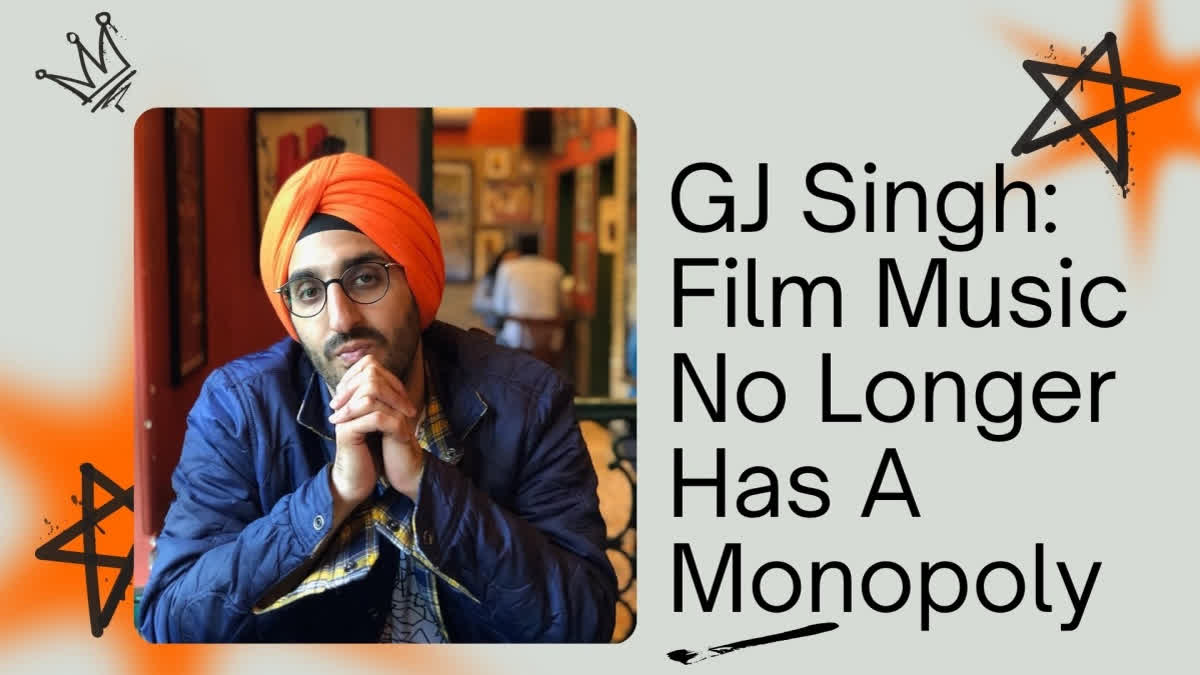
Bollywood may have been the dream for singer-composer GJ Singh but independent Punjabi music became the freedom.
GJ Singh left his corporate job as a computer engineer to become a film music composer and indie artist (ETV Bharat)

There are probably easier ways to become a music composer than working as a computer engineer during the day and making songs at night. At 23, Delhi-bred, Mumbai-based GJ Singh was doing exactly that. His mornings belonged to corporate life. His nights belonged to music. There were no glamorous studios, no certainty that anyone would hear what he was making, and certainly no guarantee that the songs accumulating on his computer would eventually become a film soundtrack. There was just a young musician trying things, staying awake too long and slowly building a “bank” of songs.
Then one meeting changed things. One of those songs eventually found its way into O Teri, the 2014 political comedy directed by Umesh Bist and produced by Atul Agnihotri and Alvira Khan Agnihotri. Among the soundtrack’s songs, it was Akhan Vich that GJ remembers most fondly. It was also the song that, in some ways, revealed the kind of musician he was becoming. “I was new and I did not play by the rules at all,” GJ says. “I would experiment in different ways,” he tells ETV Bharat in a telephonic interview.
That instinct is important to understanding GJ’s career. Because even when he was working inside Bollywood, he wasn’t particularly interested in behaving like someone who had been handed a Bollywood rulebook.
GJ believes the days of film music on the charts are numbered (ETV Bharat)
The Song That Happened In Two Hours
Akhan Vich sung by GJ himself along with his brother Jaspreet Jasz and popular playback singer Neeti Mohan, was made pretty quickly. GJ had a meeting coming up, and the song was created just two nights before it. The entire scratch was put together in about two hours. The next day, he went straight from his job to the meeting. The song was barely finished. Some of the lyrics were still essentially placeholders. But there was something about it that worked. “It was played at a film-industry party and stayed on repeat for much of the night. People began approaching me, asking what the song was,” he recalls.
There was another unusual thing about Akhan Vich: there was no bass track. GJ had allowed the kick drum to handle the low end instead. “It doesn’t have a bass line. Nobody notices it,” he says. That might sound like a small production detail, but for GJ it represents something larger. He was young enough not to know which rules he was supposed to break.
He was also listening closely to Michael Jackson and Quincy Jones at the time, and some of that influence found its way into the production. The song was eventually given a more recognisably Bollywood treatment for the film. That meant changing some of the original production choices. And that, GJ discovered, was the other side of getting a song into a movie.
Song Banks And Studio Pet Peeves
Many film songs later, GJ doesn’t romanticise his time in Bollywood. He understands why the system works the way it does. “Film composers usually create songs in advance, building a bank around familiar situations: romance, heartbreak, parties, dance numbers and those songs may later be matched to a particular film, actor or sequence,” he tells us. The problem is what happens afterthe song enters the machinery. “There will be actors who will have a problem with the song, or directors for that matter,” he says. “Everybody wishes to add their element.” There are, in other words, a lot of people who suddenly become interested in your song once it belongs to a movie. And GJ learnt an uncomfortable but useful lesson: if you want your track to become part of a film, you have to compromise on your original idea.
“When you’re making music for yourself, the situation is completely different. You have an idea, you follow it, you compose, produce, finish it. And, assuming nobody has physically stopped you, you release it,” he says. For GJ, that freedom became increasingly important.
Why He Chose Independent Music
His independent work has largely been created with his brother, multi-lingual playback singer Jaspreet Jasz. The two may sometimes disagree about creative decisions, but the disagreement itself is part of the process. GJ admits that he was the more rigid one when they began working together. “Over the years, I have learned to be more flexible,” he says.
GJ’s musical interests have continued to expand. He sings, composes and produces, although composition and production currently consume more of his time than he would like. His musical journey began with singing. His background in computer engineering, meanwhile, gave him an unusual comfort with technology and production. It is almost as though his two careers eventually met in the middle. The engineer learned how systems work. The musician learnt when to ignore them.
The Strange Future of Film Music
GJ has a strong view about the changing Indian music industry. For decades, film music was effectively the country’s biggest distribution system. If you wanted to be heard at scale, getting a song into a film was one of the most obvious routes. GJ now believes that model is weakening, and he points to Punjabi pop as one of the clearest examples.
“Punjabi artists,” he says, “took financial risks to release music independently and developed identities outside cinema. The result is a Punjabi music industry that now travels globally without needing Bollywood’s permission. The same thing is happening across other Indian languages and music scenes. You have independent artists from the South, regional rappers, Marathi musicians, singer-songwriters, bedroom producers making music at home, artists who can distribute their work without waiting for a film producer to approve it. Anyone right now can immediately release their music.” You don’t have to wait to be discovered. You can simply put the song out.
GJ sees another interesting development in the rise of independent music: licensing. An independent song can first find an audience on its own and then appear in an OTT series or film. The direction of travel has changed.
“Previously, the film could make the song famous. Increasingly, the song can arrive with its own audience and then make the film scene more memorable,” he says. For GJ, that is one reason he thinks film music’s dominance will eventually decline. “The newer artists are no longer waiting for their songs to be released,” he says. They don’t necessarily need a movie, and once they understand that, the old hierarchy starts to look less permanent.”
The Punjabi Bond Song He Wants To Make
For someone who has spent years making music, GJ still has at least one ambition sitting in the back of his head. He wants to make a Punjabi song that sounds like a James Bond theme. Not a Punjabi song with a Bond reference; a proper Punjabi song built with the kind of orchestration associated with Bond films: dramatic arrangements, big strings, cinematic scale and a melody that knows it is entering the room.
It is exactly the kind of idea that makes sense for GJ because it combines several things he enjoys: songwriting, production, experimentation and the pleasure of putting two musical worlds together. Whether it works is another question. GJ doesn’t believe musicians can predict that anyway.
The music industry currently talks a lot about hooks. Make the hook catchy. Make it short, suitable for reels, get to the memorable part quickly. GJ isn’t convinced. “Hooks have always existed,” he points out, “but there is no mathematical formula for a successful song. Sometimes the section everyone worked on becomes the hit. Sometimes it is an entirely different part. Sometimes the thing that catches fire wasn’t even intended to be the song’s most important moment. You will never come to know,” he says. “What works is never in your hand.”
For GJ, that uncertainty is part of the appeal. The musician’s job is not necessarily to predict what people will love. It is to recognise an idea when it arrives, work on it honestly and then let it go into the world. He describes himself as a vessel for that idea. It is a suitably non-engineering answer from a man who once spent his mornings thinking like a computer engineer and his nights trying to make songs.
The next phase is already taking shape. GJ has collaborations planned, more singles with Jaspreet Jasz, live shows towards the end of 2026 and a Punjabi R&B song that he describes as particularly experimental. There is also an unreleased song he has returned to. Originally, it was more guitar-driven. This time, he has completely reworked the production. That sounds like a small detail, but it captures GJ’s approach rather well. He could simply repeat something that worked but he doesn’t seem particularly interested.
After all, this is the musician who made a Bollywood song without a bass line, stayed awake making music after his engineering job, discovered that films came with too many opinions and eventually found a bigger sense of freedom in independent Punjabi music. The corporate job was eventually left behind. The sleepless nights, apparently, were not.
